
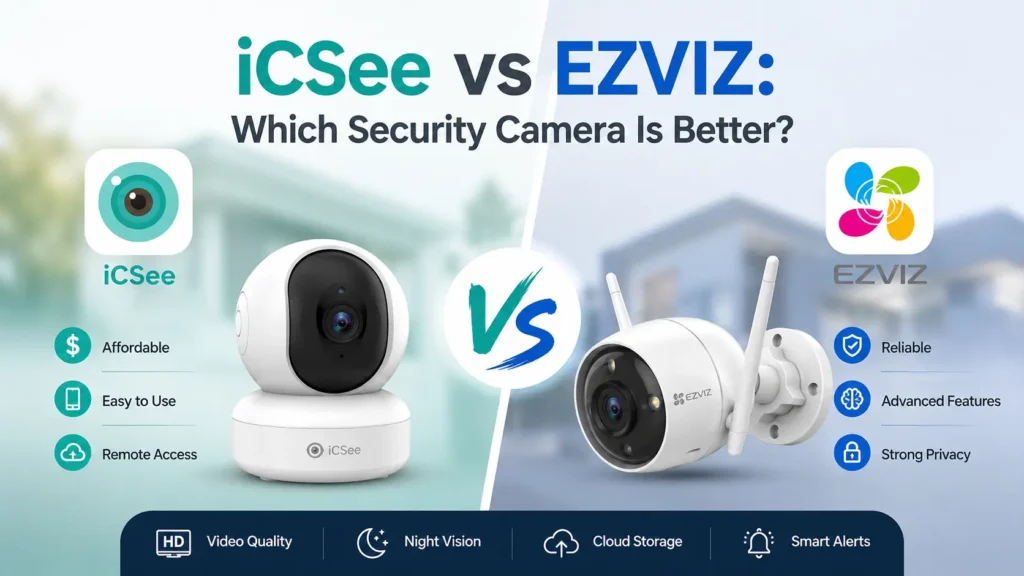


If you have spent any time shopping for a budget security camera, you have probably run into both of these names. Sometimes they even show up on the same product page. That alone causes confusion.
This article exists to clear that up. We’ll explain what iCSee and EZVIZ actually are, where they overlap, and where EZVIZ genuinely pulls ahead. By the end, you should know exactly which one fits the camera you’re about to buy — and why.
The comparisons below come from a real feature-by-feature breakdown across both apps, not just general impressions. So you can see the actual gaps instead of guessing at them.
Quick Answer: iCSee vs EZVIZ
EZVIZ is a real camera brand, built by one company that started as a Hikvision spinoff. iCSee is not a brand at all. It’s an app that dozens of unrelated factories slap onto their hardware, then sell under whatever store name they picked that month.
So this isn’t really a fair fight between two products. It’s one company versus a scattered category of hardware that happens to share an interface. EZVIZ wins on features, support, and update consistency. iCSee wins on price — and that’s really the whole trade-off in one sentence.
Short version, if you are in a hurry:
- Pick EZVIZ if you want a deeper feature set, smart home support, and one company you can actually call when something breaks.
- Pick iCSee if price is what matters most and you are willing to accept some unevenness in quality and support.
Now, the longer version — including a feature comparison pulled from real product data.
What Are You Really Comparing?
Most of the confusion around this comparison starts here.
EZVIZ builds its own hardware, runs its own cloud service (branded CloudPlay), and ships its own firmware updates. It grew out of Hikvision, one of the largest video surveillance manufacturers on earth. Whatever camera you buy under the EZVIZ name, there’s a single company standing behind it.
iCSee, on the other hand, isn’t a company you can point to. It’s software. Small camera factories license or bundle this app with their hardware, then sell the finished product under a rotating cast of store names on Amazon, AliExpress, and similar marketplaces.
Solar-powered outdoor cameras, cheap pan-tilt-zoom (PTZ) models, budget NVR kits — all of these show up running iCSee. They’re made by sellers who may not exist under the same name a year from now.
Which means the real comparison isn’t EZVIZ vs. iCSee at all. It’s one accountable manufacturer against a whole category of unbranded hardware that happens to share an app. The interface might look identical from one iCSee camera to the next. But the sensor inside, the WiFi chip, the housing, even the update schedule — all of that can vary wildly depending on who assembled it.
iCSee vs EZVIZ Feature Comparison: Where the Real Gaps Show Up
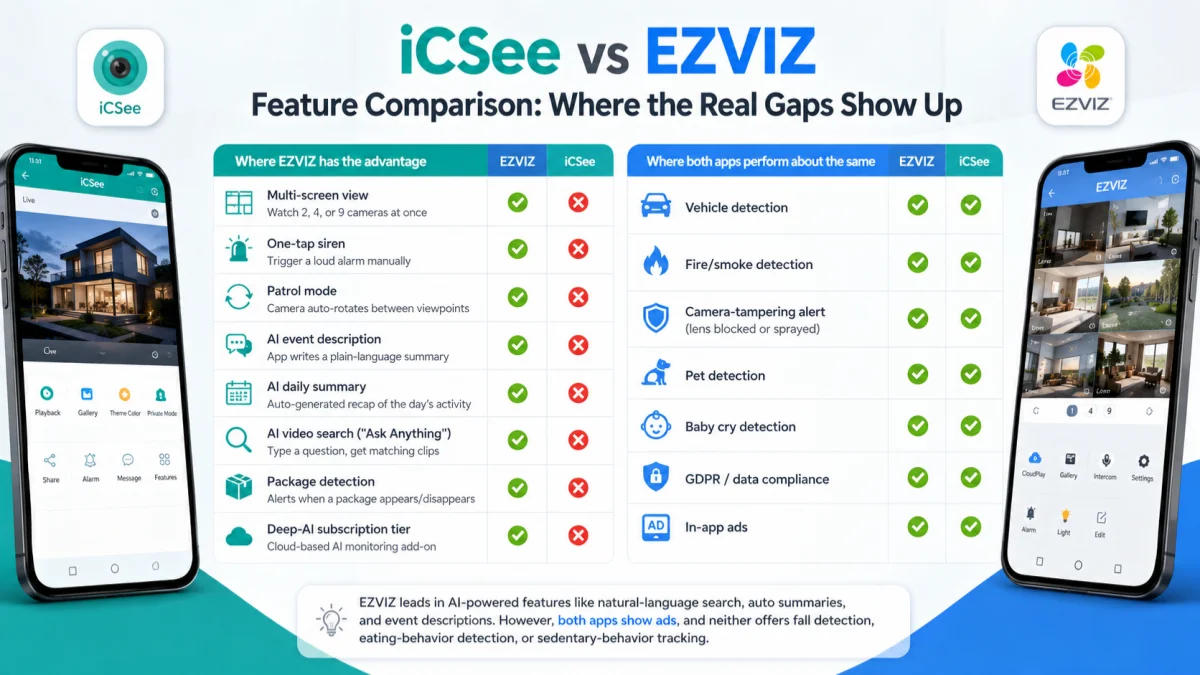
We compared actual feature lists across several major security camera brands, EZVIZ and iCSee among them. A few gaps stood out immediately, and a few features turned out to be a wash.
Where EZVIZ has the advantage?
| Feature | What it does | EZVIZ | iCSee |
|---|---|---|---|
| Multi-screen view | Watch 2, 4, or 9 cameras at once on one screen | ✅ | ❌ |
| One-tap siren | Trigger a loud alarm manually to scare off intruders | ✅ | ❌ |
| Patrol mode | Camera auto-rotates between saved viewpoints on a schedule | ✅ | ❌ |
| AI event description | App writes a plain-language summary of what happened (“a person walked by your door”) | ✅ | ❌ |
| AI daily summary | Auto-generated recap of the day’s activity | ✅ | ❌ |
| AI video search (“Ask Anything”) | Type a question, get matching video clips | ✅ | ❌ |
| Package detection | Alerts when a package appears or disappears | ✅ | ❌ |
| Deep-AI subscription tier | Cloud-based AI monitoring add-on | ✅ | ❌ |
Where both apps perform about the same?
| Feature | EZVIZ | iCSee |
|---|---|---|
| Vehicle detection | ✅ | ✅ |
| Fire/smoke detection | ✅ | ✅ |
| Camera-tampering alert (lens blocked or sprayed) | ✅ | ✅ |
| Pet detection | ✅ | ✅ |
| Baby cry detection | ✅ | ✅ |
| GDPR / data compliance | ✅ | ✅ |
| In-app ads | ✅ | ✅ |
The AI column is really where EZVIZ separates itself. Natural-language search, auto-generated summaries, event descriptions written in plain English — iCSee has none of it, at least not in this comparison.
But it’s worth resisting the urge to declare EZVIZ the flawless winner here. Both apps run ads. Neither one offers fall detection, eating-behavior detection, or sedentary-behavior tracking, so if you were hoping EZVIZ covered every advanced care feature, it doesn’t.
Accountability and Build Quality
Spec sheets rarely explain why one product ends up frustrating people six months in and another doesn’t. Usually it comes down to accountability, plain and simple.
When an EZVIZ camera develops a bug, or worse, a security flaw, one company owns the fix. That company has a reputation on the line, which tends to speed things along.
An iCSee camera with the same problem is a messier situation. The seller you bought from might not be the one who wrote the app. Support tickets often bounce between marketplace sellers who have little real power to touch the software. That’s a structural issue, not a knock on any individual product.
None of this means every iCSee camera is junk — plenty hold up fine for basic monitoring. But the wildly mixed reviews you’ll see across iCSee listings usually trace back to different factories shipping under the same app, not one consistent product getting inconsistent reviews.
That same pattern shows up in the hardware itself. EZVIZ sticks to a fairly steady lineup: C-series cameras for indoors, H-series for outdoor and battery-powered use, plus its video doorbells. Controlling its own manufacturing means quality stays roughly consistent within a given price tier.
iCSee can’t offer that same guarantee. Two cameras running the identical app might use completely different sensors, WiFi chips, and weatherproofing, even though the software makes them look like siblings. The app layer is standardized. The hardware underneath it is anything but.
Outdoors, this gap tends to show up faster. Weatherproofing and low-light performance swing considerably between cheap OEM batches, and there’s rarely any way to tell from a product listing which batch you’re getting.
App Experience, Cloud Storage, and Local Recording
The basics are covered on both sides — live view, motion alerts, two-way audio, night vision, playback. Nobody’s reinventing anything there.
Where the two apps split is in the details. EZVIZ offers more granular notification settings and motion filtering that’s noticeably better at ignoring shadows and pets. As the table above shows, it also has a far deeper AI feature set built around natural-language descriptions and search.
iCSee’s app, by comparison, can feel a step behind. Translations occasionally read a little awkward, and how well person detection actually works depends heavily on which specific camera model you happened to buy.
Storage tells a similar story. EZVIZ runs CloudPlay, a paid cloud storage plan with pricing posted right on its website — the same basic model you’d recognize from Ring or Arlo.
iCSee is murkier here. Storage terms, server location, even whether cloud storage exists at all, shift from camera to camera depending on the seller. A lot of iCSee cameras lean mainly on local storage — microSD card or NVR — rather than any polished cloud tier. Oddly enough, that can actually work in favor of privacy-conscious buyers who’d rather skip a subscription altogether.
One practical note: check the exact listing for whatever camera you’re considering. “Cloud storage available” doesn’t mean the same thing twice across different iCSee products.
Security, Privacy, and Data Compliance
This is a bigger deal than app polish or camera resolution, and it deserves more than a passing mention.
Hikvision, the company behind EZVIZ’s underlying technology, has faced genuine regulatory scrutiny. Back in November 2022, the U.S. FCC blocked new authorizations for Hikvision equipment sales domestically, citing national security concerns. Before that, the 2019 National Defense Authorization Act had already kept Hikvision gear out of U.S. federal networks.
The UK has imposed comparable restrictions on Hikvision-linked equipment at sensitive government sites. EZVIZ operates as a separate consumer brand from Hikvision’s surveillance division. Still, anyone wary of hardware tied to Chinese state-linked companies should know this history before assuming EZVIZ is automatically the “safe” pick.
iCSee’s risk looks different — it’s a question of unclear ownership rather than corporate ties. Since so many unrelated sellers use the app, there’s frequently no clear privacy policy tied to your specific camera. There’s often no fixed patch schedule either, and no straightforward way to check where your footage actually lives.
Budget IoT cameras as a category have a well-documented history of weak default passwords and unpatched firmware. White-label products are often exactly what security researchers flag, precisely because no single company sticks around to maintain them.
Neither brand comes out spotless. Both include in-app ads, and both claim GDPR compliance, so this isn’t a case where one clearly beats the other on privacy. Whichever camera you end up with, the same basic habits apply: change the default password right away, install updates when they’re offered, and never expose the admin panel directly to the internet.
Price, Support, and Everyday Practical Differences
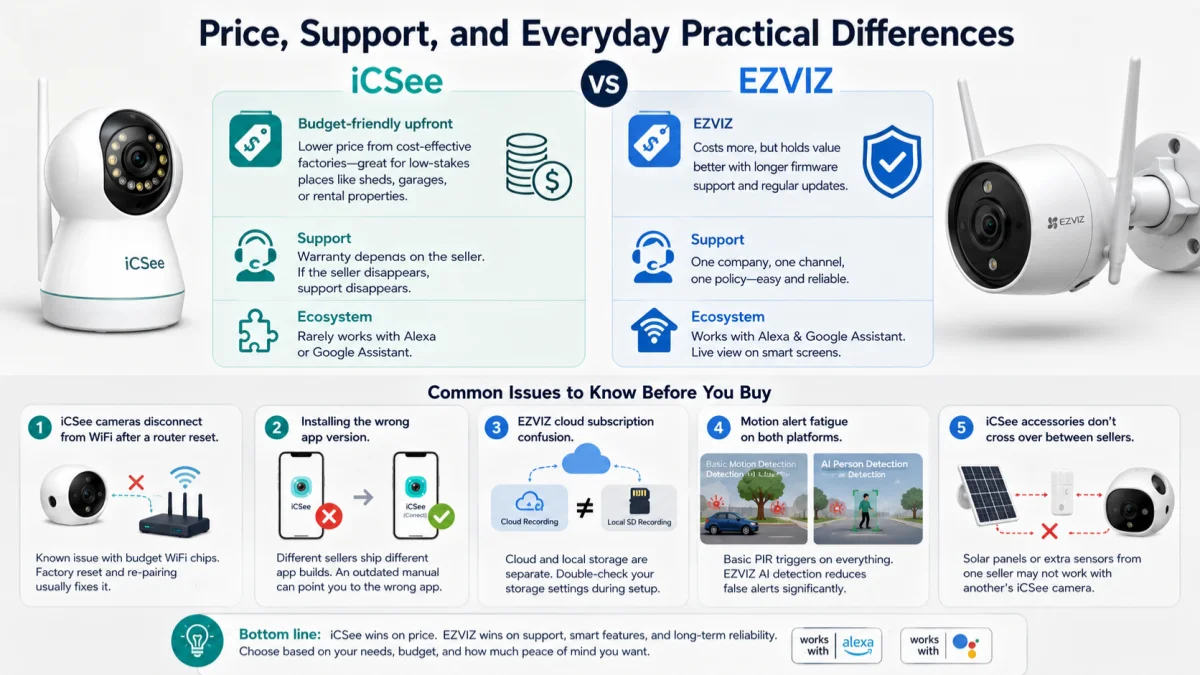
iCSee cameras are almost always the cheaper option upfront, which makes sense given they’re built by low-cost factories competing mostly on price. For something low-stakes — a shed, a garage, a rental property where losing the camera in a year wouldn’t sting much — that trade-off is often reasonable.
EZVIZ costs more, but it tends to hold its value better through longer firmware support. Anyone already using Alexa or Google Assistant will also get more mileage out of it, since EZVIZ supports voice commands and live-feed display on smart screens. iCSee rarely connects with those ecosystems, mostly because the app has to run across too many unrelated hardware brands to prioritize deep smart home support.
Warranty support follows the same pattern. EZVIZ gives you one company, one support channel, one policy. With iCSee, your warranty rides entirely on the seller you bought from — not the app developer — so if that seller goes quiet or drops the product line, nobody bigger steps in to help.
A few recurring complaints show up often enough that they’re worth knowing before you buy:
- iCSee cameras disconnecting from WiFi after a router reset. This is a known issue with budget WiFi chips. A factory reset and re-pairing usually clears it up.
- Installing the wrong app version for a specific iCSee camera. Different sellers ship different app builds, so an outdated manual can point you toward the wrong app entirely.
- EZVIZ cloud subscription confusion. Some users assume local SD recording is included when they’ve only set up cloud recording — or the other way around. Worth double-checking your storage settings during setup.
- Motion alert fatigue on both platforms. Basic PIR motion sensors fire on tree branches, passing cars, and shifting light. EZVIZ’s AI-based person detection cuts down on this noticeably more than most iCSee cameras manage.
- iCSee accessories that don’t cross over between sellers. Solar panels or extra sensors bought from one seller may simply not work with another seller’s iCSee-branded camera, even under the same app.
Which Camera App Should You Choose?
If you want one accountable company behind the product, smart home integration, a genuinely deep AI feature set, and support you can actually reach — EZVIZ is the obvious pick. That’s especially true for a long-term home security setup you don’t want to revisit every year.
iCSee makes more sense when budget is the deciding factor and the location is lower-stakes — a shed, a driveway, somewhere a hardware failure wouldn’t be a real setback. Even then, it’s worth checking the specific seller’s reviews, return policy, and whether that particular camera actually supports local storage before buying.
And if you need documented compliance for a business, an HOA, or a government-linked property, neither of these is really the right category. Look toward established commercial-grade brands instead.
Neither app is “bad,” in the end. They just serve different buyers. EZVIZ suits people who want consistency, a real AI feature set, and support that doesn’t disappear after the sale. iCSee suits people chasing the lowest price who can live with more variation in quality.
Frequently Asked Questions
Is iCSee owned by the same company as EZVIZ?
No corporate link exists between them. EZVIZ is one branded product line, originally spun off from Hikvision, with its own dedicated hardware and software team. iCSee is licensed software that gets bundled onto hardware from many independent factories instead.
Can I use the EZVIZ app with an iCSee camera, or the other way around?
No. Each app only pairs with the specific hardware and firmware it was built for, so swapping doesn’t work.
Is iCSee safe to use for home security?
That depends on which factory built your specific camera, since privacy and update practices shift from seller to seller. Whatever brand you pick, changing the default password and keeping the admin panel off the open internet go a long way toward lowering the risk.
Does EZVIZ require a monthly subscription?
No. Local recording to a microSD card or NVR works without paying anything. The CloudPlay plan exists purely as an optional add-on for off-site backup.
Does iCSee offer AI features like EZVIZ?
Not yet, based on current feature data. This is where the two apps diverge most — EZVIZ’s natural-language summaries and video search don’t have an iCSee equivalent.
Which one holds up better outdoors?
Lean toward EZVIZ if consistent weatherproofing matters to you, since it manufactures its own hardware end to end. Outdoor iCSee cameras aren’t automatically worse, but performance depends heavily on the specific seller, so check model-specific reviews first.